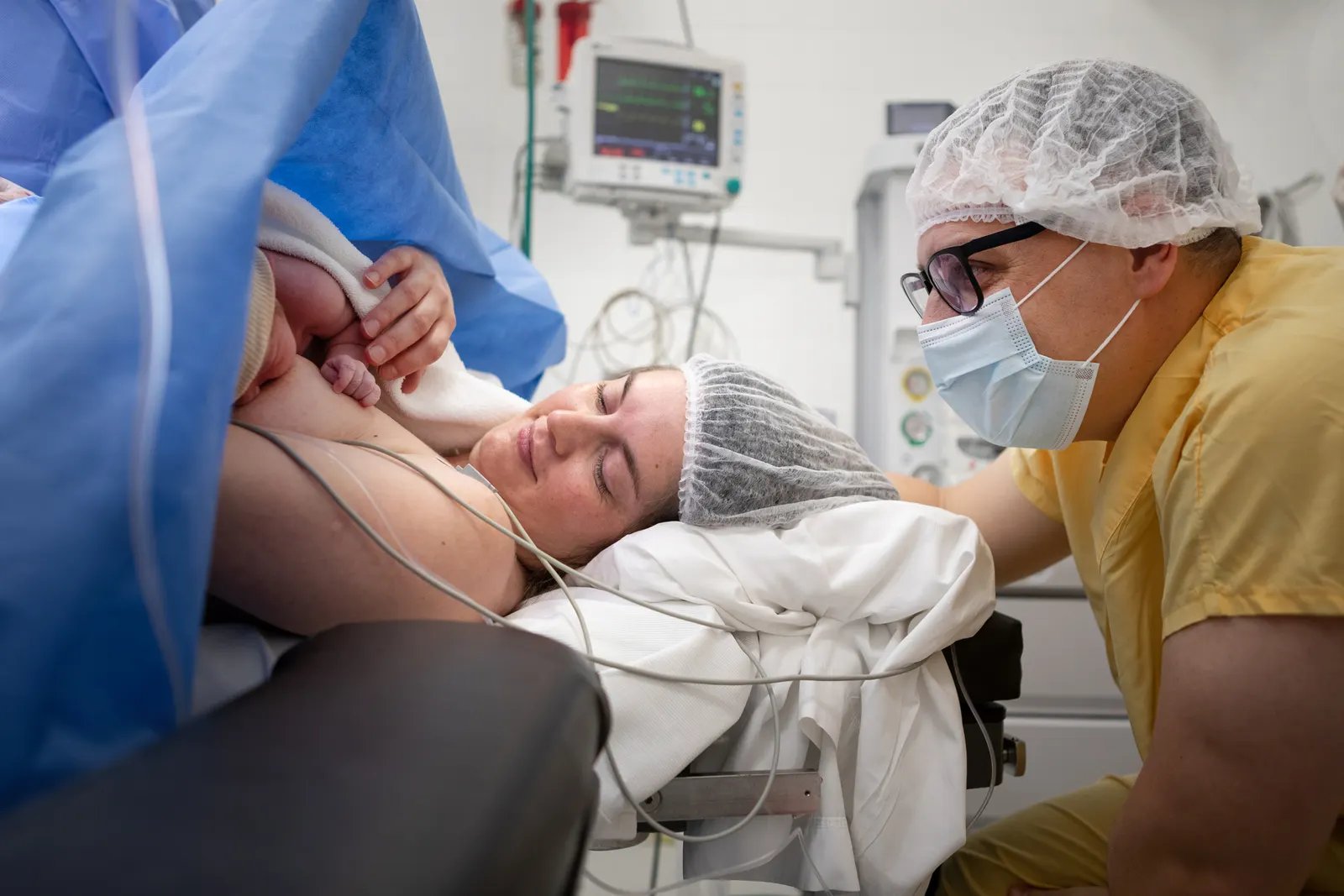
Family-Centered C-Section: Options You Can Ask About
A C-section can still feel personal. Learn about clear drapes, skin-to-skin, delayed cord clamping, support people, feeding, and other options.
BirthX Team · · 6 min read
Download summary (PDF)A C-section is surgery, but it's also the birth of your baby. When you and your baby are stable, there may be ways to make the operating room feel more connected, personal, and centered around your family.
If you're planning a C-section, ask about these options at a prenatal visit, well before your birth. If a C-section becomes necessary during labor, your support person or doula can help share the preferences that still matter to you.
What Is a Family-Centered C-Section?
You may hear it called a family-centered, gentle, or natural C-section. All three names describe the same idea. It's still a surgical birth, but one that makes room for connection and choice.
There's no single checklist that defines it. The goal is to safely bring some of your birth preferences into cesarean care whenever circumstances allow.
Before Birth
Have a Support Person With You
Many hospitals allow one support person in the operating room for a C-section done with regional anesthesia. Policies may differ for emergency surgery or general anesthesia, depending on the hospital, the situation, and staffing.
Ask where your support person will sit, when they can come into the operating room, whether they can take photos, and whether they can stay with your baby if the two of you need to be separated.
Ask About a Clear or Lowered Drape
A traditional surgical drape blocks your view of the operation. If you want to see your baby being born, ask whether the hospital offers a clear drape or can briefly lower the drape at the moment of birth.
Not everyone wants to watch, and you don't have to. The goal is having the option when it can be done safely.
Talk About Your Arms and Monitoring
Operating room setup varies. In some hospitals, your arms rest on arm boards while monitors and IV tubing are attached. Family-centered approaches may adjust where equipment goes so it's easier to hold or touch your baby.
Ask your anesthesia team what's possible without interfering with safe monitoring or the sterile surgical area.
Set the Atmosphere
Small details can make an operating room feel less clinical. Depending on hospital policy and the needs of the surgical team, you may be able to choose music, have your support person take photos, or ask for a quieter room around the moment of birth.
If something is especially meaningful to you, ask ahead of time rather than assuming it is or isn't allowed.
Decide How Much You Want to Hear
Some people want the surgical team to explain each step. Others would rather hear as little medical detail as possible. Tell your team what helps you feel calm and involved.
If your baby's sex is a surprise, you can also decide who shares it: someone on the team, your support person, or you, by seeing for yourself.
At Birth
Ask About Delayed Cord Clamping
ACOG recommends waiting at least 30 to 60 seconds before clamping the umbilical cord for most healthy newborns, both full-term and preterm. Delayed cord clamping is often possible during a C-section, too.
Sometimes the cord needs to be clamped sooner, such as when you're not stable, there are problems with the placenta or cord, or your baby needs immediate care away from the operating table. Ask how your hospital handles delayed cord clamping during cesarean birth.
Ask About Immediate Skin-to-Skin
If you and your baby are stable, skin-to-skin contact may be possible in the operating room. Your baby can be placed on your upper chest while surgery continues, with the team helping keep you both warm and safely positioned.
If immediate skin-to-skin with you isn't possible, ask whether your support person can hold your baby skin-to-skin until you're able to.
Ask Whether a Maternal-Assisted C-Section Is Offered
A small number of hospitals offer a maternal-assisted C-section. After the surgeon delivers your baby's head, you help lift your baby out and onto your chest, wearing sterile gloves. It's rarely offered and takes advance planning, but if it interests you, it's worth asking about.
After Birth
Start Feeding Early
If you plan to breastfeed or chestfeed, you may be able to start in the operating room or recovery area. You don't need a perfect first latch for early contact to matter. Holding your baby skin-to-skin and giving them time to nuzzle and explore is a good start.
If you plan to formula feed, you can still ask about skin-to-skin, holding your baby, and being involved in the first feeding. Family-centered care is about connection and informed choice, not one feeding method.
Keep Your Baby With You
When your baby is doing well, routine newborn care can often happen close to you. Ask whether weighing, measuring, medications, and other routine tasks can wait until after your first skin-to-skin time or be done in the operating room or recovery area.
You can also ask to delay your baby's first bath. Many hospitals now wait at least several hours, which gives you more uninterrupted time together.
If your baby needs additional medical care, ask whether your support person can go with them and how the team will keep you updated.
What Changes in an Emergency?
Family-centered options depend on what's happening medically. In an urgent situation, the team's priority may need to be delivering your baby quickly, controlling bleeding, supporting your breathing or blood pressure, or giving your baby immediate care.
That doesn't mean your preferences were unimportant. It means some options may not be safe or practical in that moment. Once things are stable, ask which parts of your plan can be brought back in.
Later, when you're ready, you can ask your care team to walk you through what happened and why. Many people find this helps them make sense of an unexpected birth.
Questions to Ask Your Care Team
Bring these to a prenatal visit, and ask which are routine, which are possible on request, and which aren't offered.
Before birth
- Who can be in the operating room with me?
- Can my support person take photos or video?
- Can I play my own music?
- Can someone explain what's happening during surgery, or keep the room calm and quiet?
- Can my arms and equipment be positioned so I can hold my baby?
At birth
- Can I use a clear drape or have the drape lowered when my baby is born?
- Can I see or touch my baby right away?
- Can we delay cord clamping if my baby and I are stable?
- Can my baby have skin-to-skin with me in the operating room?
- If I can't do skin-to-skin, can my support person?
- Do you offer maternal-assisted C-sections?
After birth
- Can feeding begin in the operating room or recovery area?
- Can routine newborn care happen while my baby stays with me?
- Can my baby stay with me in recovery?
- Can we delay my baby's first bath?
- If my baby needs to leave the room, can my support person go too?
A C-Section Can Still Be Your Birth
You may not be able to control every part of a cesarean, but you can ask what's possible. Some hospitals already use family-centered practices routinely. Others may need you to request them in advance.
Bring your priorities to a prenatal visit and ask your provider what your hospital can offer. A C-section doesn't erase your role in your baby's birth. You still deserve information, choices, connection, and respectful care.
To learn more:
- New to C-sections? Our guide to what to know about a C-section covers why they happen and what to expect.
- Planning a repeat C-section? Our VBAC vs. repeat C-section guide can help you weigh your options.
- Getting ready for recovery? Our guide to recovering from a C-section covers what to expect at home.
Sources
For education only; not a substitute for individualized medical advice. Sources reviewed for this article:
Want to save or share this?
Get a one-page summary to print or bring to your next appointment.